


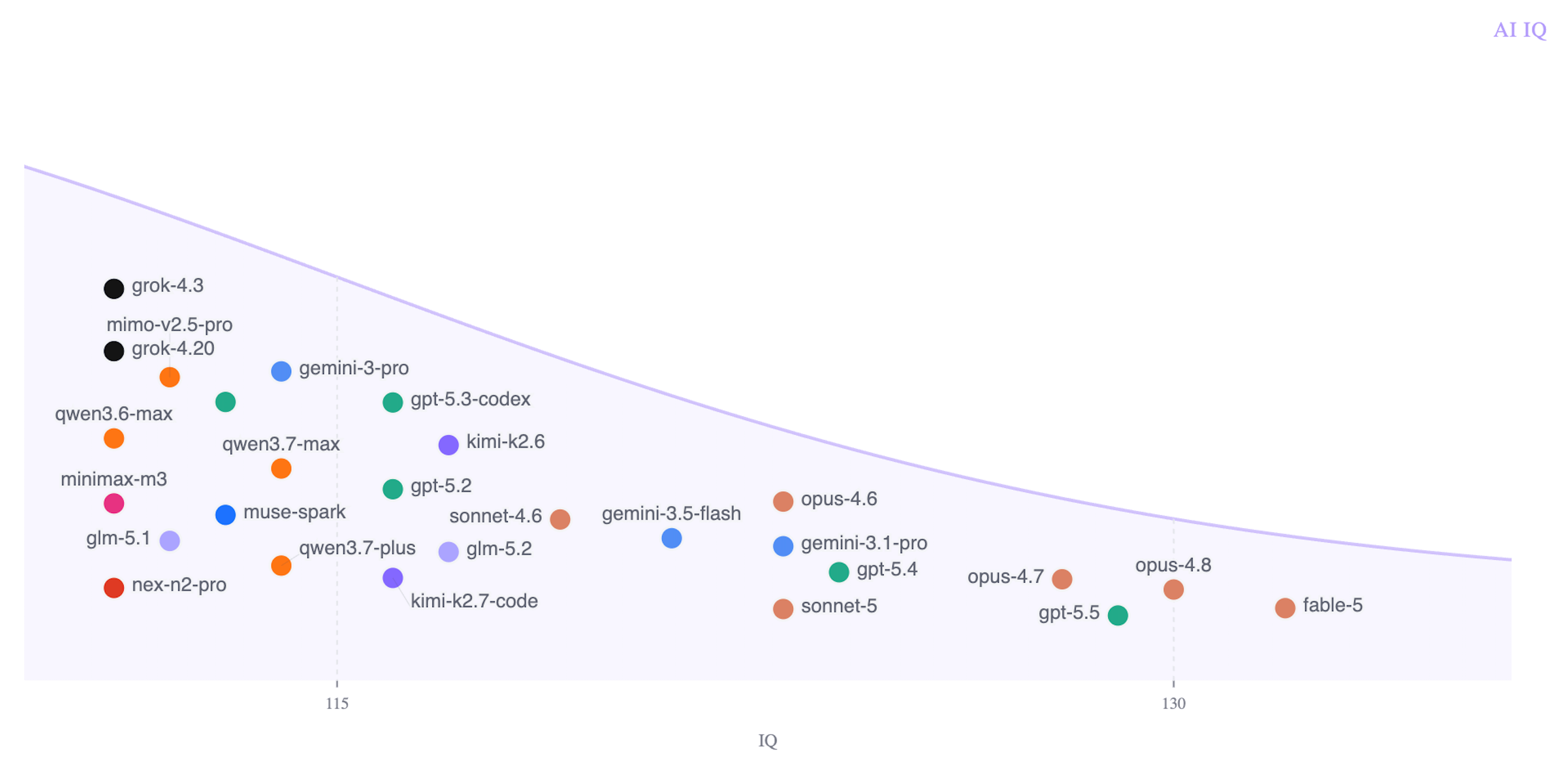
Fable 5 has the top composite score on AI IQ this month, an estimated IQ of 132, a couple of points ahead of Opus 4.8 (130) and GPT-5.5 (129). If you’ve been watching the board, that’s about where you’d expect things to sit.
The ranking has never really been the point of these posts, though. The point is the texture underneath it, and this month there’s plenty of it. A single composite number flattens a lot: Fable 5, Opus 4.8, and GPT-5.5 are all top-tier models, and they’re top-tier in different shapes.
Fable 5 tops the overall ranking and leads four of the seven capability dimensions, but it’s the most expensive model on the board by a wide margin.
Opus 4.8 is the model I’d hand a long, unsupervised job to. It’s the least likely to drift off task or make something up while it runs.
GPT-5.5 is the strongest raw reasoner when a problem is genuinely hard. It has the highest math and abstract-reasoning scores anywhere.
Gemini 3.1 Pro gives you most of the frontier for a fraction of the money.
GLM 5.2 and Kimi K2.6 aren’t frontier models overall, but they hit frontier-level numbers in specific places. GLM 5.2 in particular goes toe-to-toe with the top models on design.
That’s the map. Here’s how I’d actually read it.

First, a word about benchmark cards
You’ve seen the launch posts. Every lab picks the handful of benchmarks it happens to win and puts them on a slide. None of it’s fake, exactly, it’s just curated. That’s the whole reason AI IQ exists: it takes public, source-backed benchmark results and folds them into seven dimensions (abstract reasoning, math, science, app building, production engineering, computer use, and reliability) and the composite uses all seven. Where a model hasn’t been tested, we don’t quietly give it the benefit of the doubt.
The top three
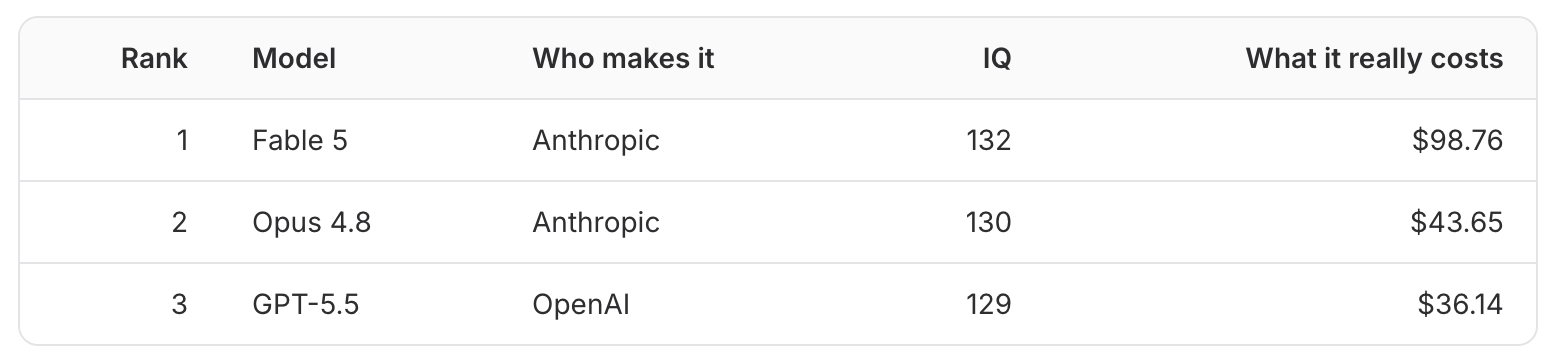
Just off the podium: Opus 4.7 (#4, IQ 128), GPT-5.4 (#5, IQ 124, and a lot cheaper at $24.74), and Gemini 3.1 Pro (#6, IQ 123).
Fable 5, the “break glass in case of emergency” model. It’s the smartest thing on the board. It leads science (143), app building (145), production engineering (142), and computer use (136), and it wins the nastiest math AI IQ tracks: FrontierMath Tier 4 (87.8), Tier 1–3 (87), ProofBench (77), plus CritPt (27.1) on the science side. The catch is the bill. At $98.76 it runs about twice what Opus 4.8 costs and nearly three times GPT-5.5. This isn’t a daily driver; it’s the model you escalate to when the answer is genuinely worth the money.
Opus 4.8, the one I’d let run overnight. Second overall, and first in the thing I care about most when I’m not in the room: reliability. It posts the highest Reliability IQ anywhere (122), ahead of GPT-5.5 (119) and Fable 5 (118), and it’s got the receipts: full coverage on reliability (5/5) and computer use (7/7), plus 6/8 on production engineering and 3/4 on app building. That’s the deepest evidence base of any frontier model here. It’s #2 in production engineering (139), second in computer use (135, just behind Fable 5’s 136), and it leads on BullshitBench v2 (94), which is basically “does it push back, or just tell you what you want to hear.”
GPT-5.5, the raw reasoner. When a problem is genuinely hard, this is still the sharpest model on the board: #1 in math (141, ahead of Fable 5’s 139 and Opus 4.8’s 135) and #1 in abstract reasoning (108, just ahead of Gemini’s 106). It’s #2 in science (142) and #2 in reliability (119), with frontier-grade computer use (135). And at $36.14 it’s the cheapest of the top three.
The value plays
Gemini 3.1 Pro, the smart-money pick. Sixth overall at IQ 123, but look at the price: $10.59, a rounding error next to the top tier. It’s genuinely strong in science (141, right in the cluster with Fable 5’s 143 and GPT-5.5’s 142) and second in abstract reasoning (106). When you want most of the frontier without the frontier’s invoice, this is the easy answer.
GLM 5.2 and Kimi K2.6, frontier in spots, value everywhere else. Both land at IQ 117 overall, but that number undersells where they’re actually good. GLM 5.2 (#10, $4.93) is a real design and frontend model: its Arena.ai WebDev score (1595) tops both Opus 4.8 (1561) and Kimi K2.6 (1513), and it holds up in science (138) and computer use (128). Kimi K2.6 (#11, $5.08) is the stronger all-rounder of the two, with app building at 127 and math at 125. Point either one at high-volume work like routing layers, background agents, first drafts, and batch coding, and reach for GLM 5.2 specifically when the job is web and UI.

The cheat sheet
Best overall → Fable 5
Hardest reasoning problems → GPT-5.5
Science → Fable 5, GPT-5.5 or Gemini 3.1 Pro
Building apps → Fable 5 or Opus 4.8
Production engineering → Fable 5, GPT-5.5 or Opus 4.8
Long unsupervised jobs → Opus 4.8
Frontier on a budget → Gemini 3.1 Pro
Design and frontend on a budget → GLM 5.2
Real work, small bill → GLM 5.2 or Kimi K2.6
What I’d take away
Picking a model is a budgeting decision as much as a capability one. That “effective cost” number is the published price adjusted for how models actually get used, so the one that looks cheapest on paper isn’t always cheapest in practice, and the smartest one is usually overkill for the job in front of you.
The frontier isn’t a single throne, it’s a lineup or a roster, and it has been for a while. The people who get the most out of it aren’t the ones who picked the “right” model. They’re the ones who stopped trying to pick just one.
That’s the month. Reply and tell me what you’re routing where. I read every one.